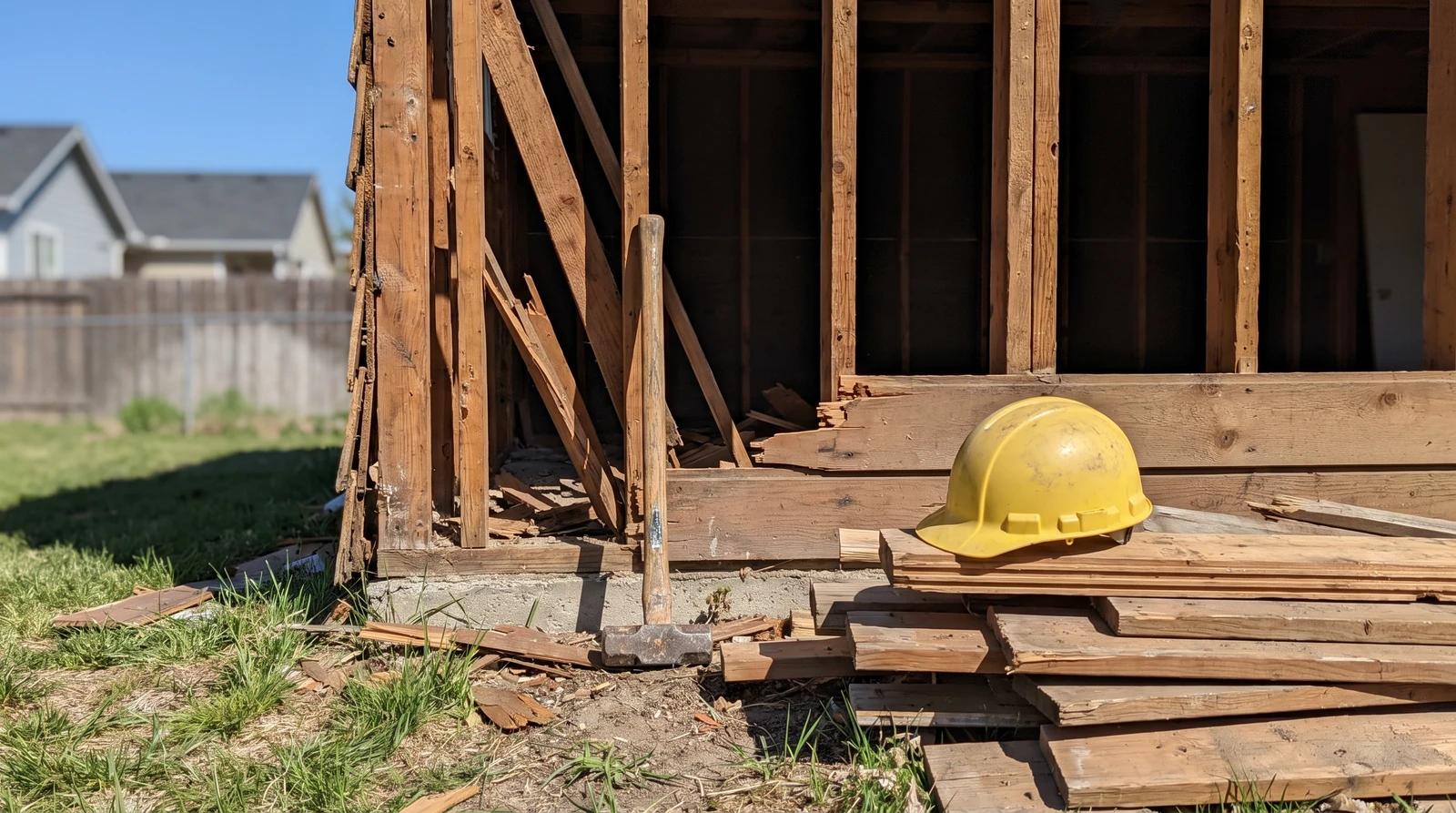
What Qualifications Do You Need to Do Demolition Work?
Here's the plain answer to what qualifications do you need to do demolition: safety training, a feel for how houses come apart, and the physical strength for heavy work. Once you tear things down for paying customers, you also need a contractor license and insurance.
There are two sides to it. A crew member needs one set of skills. The business running the work needs more. In Boise and across the Treasure Valley, that second part matters a lot if you're a homeowner about to let someone take down a house, garage or slab.
What qualifications do you need to do demolition?
On a crew, you need basic schooling, safety training, an understanding of how houses go together, and a body that can handle hard work. Nobody hands out a single license for this. These are the qualifications needed in practice.
A high school diploma or equivalent
Most construction employers ask for a high school diploma or a GED. It isn't required by law for a laborer. But it shows you can read a plan, follow written safety rules and do basic math.
That math comes up more than you'd think. You measure a slab, figure out how much comes off a roof, and sort what's recyclable from what goes to the landfill.
Safety practices and training
Safety practices are the biggest qualification on the list. Tearing things down is controlled destruction, and the word that matters is controlled.
Many workers take a short federal safety course early on. Most of the real training happens out in the field, though. You learn to read a structure before you cut into it, where to stand when a wall comes down, and when to stop and ask.
Knowledge of how structures are built
You can't take something apart safely if you don't know how it was put together. Framing, load-bearing walls, roof trusses, footings and rebar in concrete all matter. That knowledge keeps a garage from falling the wrong way.
You don't need an engineering degree. You do need to understand what's holding up what.
Physical strength and stamina
There's no getting around it. Demolition work takes real physical strength. You'll lift, pull, swing and haul all day, often in the heat of an Idaho summer or on frozen ground in January.
Stamina matters as much as raw strength. A long day of loading debris wears you down in ways a gym session doesn't.
Do you need a contractor's license?
You don't need a contractor's license to work on a crew. The business running the work does. That's the line most job-board lists skip.
Working on a crew versus running the work
A demolition worker shows up, follows the plan and sticks to good safety practices. A demolition contractor owns everything else: city approvals, utilities, insurance, disposal and the people on the crew.
If something goes wrong, the contractor carries it. That's why the requirements are different.
Contractor licensing and insurance in Idaho
Idaho requires most contractors to register with the state before they take paid construction work. The registration application asks for proof of liability insurance. It also asks for workers' comp if the business has employees.
Some cities also want a local business certificate or license. The point of all of it is simple. If a wall lands on your neighbor's fence, someone has to answer for it.
Where the permit fits in
Most cities in the Treasure Valley require demolition permits before a structure comes down. Boise, Meridian, Nampa and Caldwell each run their own building departments. Ada and Canyon County handle the areas outside city limits.
The city often wants proof that utilities are off. For older homes and commercial buildings, it may also want proof that hazardous materials have been checked.
Good to know: On a house or garage, the contractor usually files the paperwork for you. Boise Demolition does that as part of the work.
How do you become a demolition expert?
You become an expert the old-fashioned way: years on a crew, learning one task at a time. There's no shortcut, and honestly, that's a good thing.
Start as a laborer on a crew
Most people start by loading debris, pulling nails, sorting materials and cleaning up the site. It's not glamorous. It's where you learn how a job actually runs.
Learn the equipment and the order things come down in
Next comes the equipment, from hand tools and saws to machines that knock down walls and break up concrete. The order of work matters just as much.
On most house projects, the work goes in a set order. Anything worth saving goes first, then the roof, then the walls, then the foundation. Getting the order wrong is how people get hurt.
Learn the hazards: utilities, asbestos and buried lines
This is where key skills turn into real expertise. Gas, power and water have to be shut off and checked before anything starts. Buried lines have to be marked, which is what calling 811 is for.
Heads up: Older homes in Boise's North End or on the Bench can hide asbestos, lead paint or both, often in siding, roofing, old flooring and trim. Taking those out is a separate trade with its own training. A good crew member knows the warning signs and stops.
Move up to running crews
After enough time, the best workers start running crews. They size up each house, plan the order, deal with inspectors and make the calls. That's when the business side, licensing and insurance, becomes part of your world.
What to check before you hire someone to tear down a structure
Before you hire anyone to tear something down, check three things: license and insurance, who handles city approvals and utilities, and whether you get a firm written price. These questions apply to anyone you call.
Proof of license and insurance
Worth asking: Ask to see it. A licensed and insured contractor won't mind. If someone gets weird about it, that tells you what you need to know.
This matters most on residential demolition of a whole house or a detached garage close to a property line. There, a mistake can reach a neighbor.
Who pulls the permit and arranges utility shutoffs
Get a clear answer on who files with the city and who sets up the utility shutoffs. If nobody owns it, it may not happen. Then the work can stall or get red-tagged.
A firm written price after an on-site look
A real price comes from someone seeing the site in person. Size, access, what the structure is made of, whether there's a slab, and how much can be donated or recycled all move the cost.
Our **Residential Demolition Services** start with a free on-site look. You get a firm price before anything is touched, with no hidden fees.
The short version: a crew member needs safety training, structural know-how and a strong back. The business running the work needs a license, insurance and a handle on city approvals. If you're planning to take down a house, garage, shed, deck or slab anywhere in the Treasure Valley, Boise Demolition is happy to come look and give you a firm price. Give us a call at (208) 296-6153.
Frequently asked questions
Can a homeowner do the work themselves?
Often, yes, on their own property. You'll usually still need city approval and utility shutoffs. Be honest with yourself about the safety risks on anything bigger than a small shed.
Do you need special certification to handle asbestos?
Yes. That kind of removal is its own regulated trade, with specific training and accreditation. If an older home might have it, get it tested and taken out by the right people before the tear-down starts.
How long does it take to learn demolition work?
You can learn basic laborer tasks fairly quickly. Learning to read structures, run equipment and handle hazards takes years of steady work on real jobs.
Do I need a permit to take down a shed or garage?
Related reading: Residential Demolition Specifications: What a House Teardown Spec Covers and Residential Demolition Notes: What They Say and Why They Matter.
A garage usually needs one. Small sheds vary by city and county, so call your local city or county office or ask your contractor to check.
Planning a Demolition Project?
We handle permits as part of our demolition services throughout Boise, Meridian, Nampa, and the Treasure Valley. Call for a free estimate.
Call (208) 296-6153More From Our Blog
Demolition Labor Cost per Hour vs. Total Demolition Cost on a Teardown
Demolition labor cost per hour tells you little about a teardown. Learn what really drives house demolition costs and why crews price by the job.
Demolishing a Garage: How It Comes Down, Slab and All
Demolishing a garage, step by step: utilities and permits, attached vs. detached, block walls, slab removal and when an old roof needs asbestos testing.
Do I Need a Permit for Building Demolition? Who Handles What
Do I need a permit for building demolition? Usually, yes. Here's what comes before the application, who handles each step and what moves the cost.
