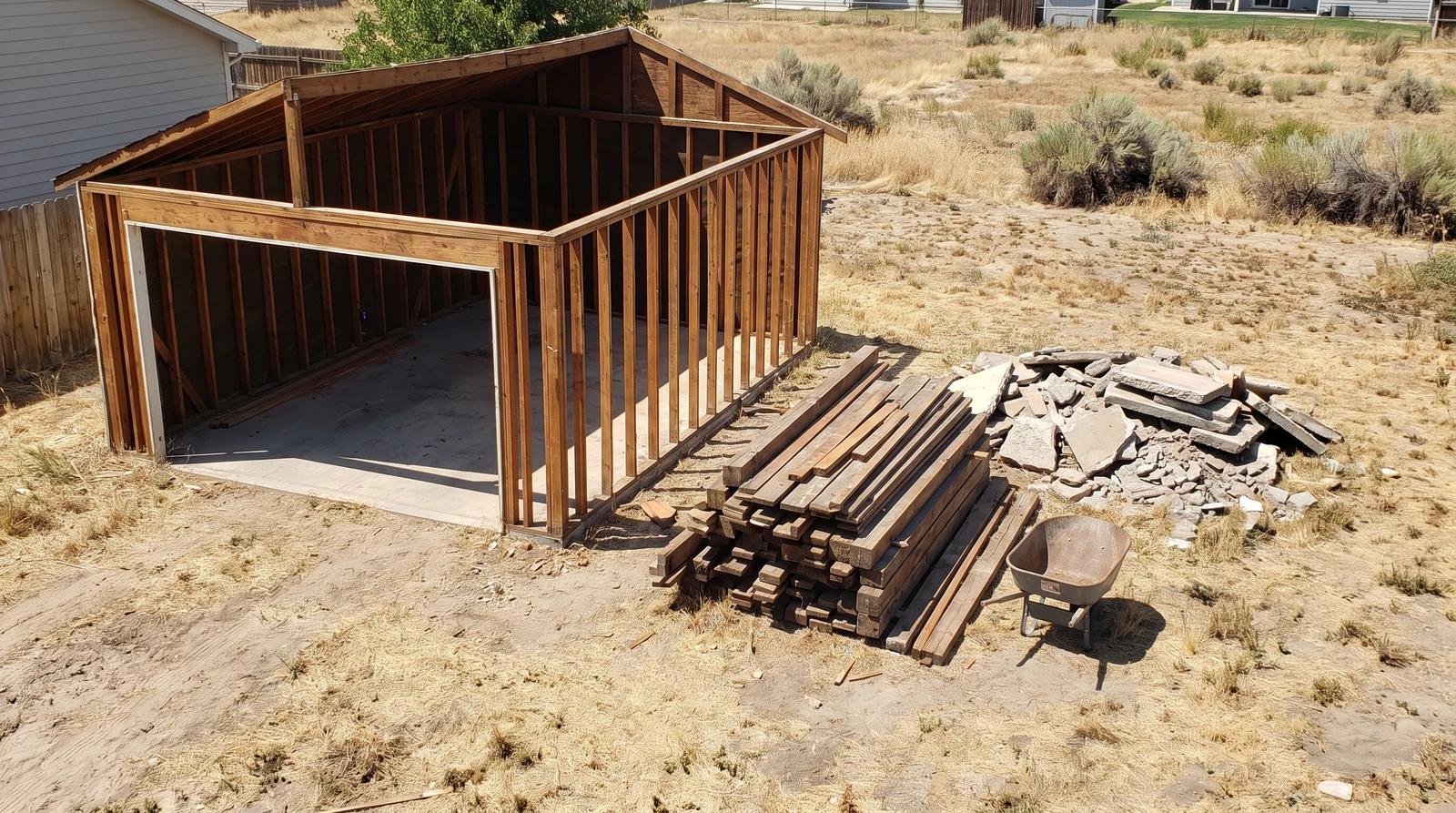
Demolition Labor Cost per Hour vs. Total Demolition Cost on a Teardown
Demolition labor cost per hour is only one part of what a teardown costs. The crew's time comes bundled with the machine, the hauling, the disposal and the permit work. That's why whole-structure demolition is usually priced by the job, not by the clock. Your total depends more on the structure, what's under it, how easy it is to reach and where the debris goes.
Boise Demolition only takes down whole structures across the Treasure Valley: houses, garages, sheds, decks, carports, pools, hot tubs and concrete.
How Much Does Demolition Labor Cost per Hour?
A demolition hourly rate depends on who's on the clock and what they brought. A rate quoted by the hour per laborer covers one person's time. It doesn't cover the excavator, the operator, the trucks, the dump fees or the permit.
A lot of the demolition work per hour numbers you see online come from small hand-demo projects. There, a couple of people with pry bars and a trailer make up most of the bill.
What an hourly rate leaves out: equipment rates and disposal
On a teardown, the crew's labor is often the smaller line. The bigger pieces are usually:
- Equipment, like an excavator or skid steer
- The operator running it, who does the skilled part of the work
- Hauling, meaning the trucks and trips it takes to clear the debris
- Disposal, which depends on how much is landfilled versus recycled
- Permit work, from the application to the final sign-off
Equipment rates and disposal don't show up in a count of the crew's work hours. A machine can finish quickly what would take a hand crew much longer. So counting time on the clock says little about the final cost.
Heads up: An hourly quote that doesn't mention equipment, hauling or dump fees can mean those get added later. Get them in writing before you compare it to a flat price.
Why hourly and per-square-foot numbers only go so far on a teardown
A demolition cost per square foot sounds more exact than an hourly rate. It's fair for comparing two similar houses. But two homes the same size can be very different to take down. A square foot of brick or basement wall takes more work than a square foot of wood framing.
One sits on a simple slab with an open driveway. The other has a full basement, a tight lot and old siding that needs testing first. An average cost figure can't see any of that. A demolition estimator standing in your yard can.
Why whole-structure teardowns get one firm price
The real work on a whole structure is in the planning, not the clock. Good demolition estimating means walking the site and checking access. It means seeing what materials the structure is built from, what's under it and where it will all end up.
So why not just quote hourly? Once the work is that well understood, one price is fairer to you. You get a number to plan around, and the crew carries the risk if the work runs long. A running clock puts that risk on you.
How Much to Hire Demolition?
What you pay a demolition contractor comes down to a few things about your structure and your lot. Boise Demolition prices by the space and the work involved.
Size, height and what the structure is built from
Every extra square foot makes more debris, and hauling it away is a real part of demolition costs. Height matters too. A two-story house takes more care to bring down than a one-story garage.
Materials change things as well. Wood framing, brick, block and metal come apart differently, weigh differently and end up in different places.
Access, utilities and what's close to the work area
If equipment can roll right up to the structure, the work moves. If it has to squeeze between fences, dodge a big tree or stay clear of the house next door, things slow down. More gets done by hand. Some older lots around Boise are tight like this.
Utilities have to be shut off and capped before anything comes down. The power and gas companies schedule their own disconnects. Their timing can decide when work starts.
Slabs, footings and basements: what's under the structure
What's under the structure can matter as much as what's above it. A slab has to be broken up and hauled. Footings go deeper and take more digging. A basement means concrete walls and a floor to break out. Then the hole has to be filled and packed down so the lot is usable.
Season plays a part too. Frozen winter ground makes digging and packing soil harder. Hot, dry summers mean more dust control.
How much gets donated or recycled versus landfilled
Not everything from a teardown has to go to the Ada County landfill. Clean materials like concrete and metal can often be recycled. Usable doors, windows and fixtures can sometimes be donated first.
Much of what Boise Demolition hauls is donated or recycled. Sorting takes effort, but landfill fees add up load by load. Mixed loads that can't be sorted are usually the priciest to get rid of.
Permits and the asbestos survey that comes first
Most whole-structure demolition needs a permit from the city or county where the property sits. Boise, Meridian, Nampa and Canyon County each run their own process. Boise Demolition can handle the permit application for you.
An asbestos survey often comes first on a house or larger building. Older homes can have asbestos in siding, roofing, flooring or ceiling texture. If the survey finds it, it has to be handled properly before demolition starts.
Worth asking: Does the bid assume the asbestos survey comes back clean? If not, abatement is separate work that happens first. Ask how each contractor handles that up front.
What Is the Cheapest Way to Demolish a House?
The cheapest way to demolish a house is usually simple. Get a firm price up front, salvage what you can before the crew arrives, and compare bids on what they include, not just the total.
Get a firm on-site price before anything is touched
Boise Demolition gives free on-site estimates and sets a firm price before anything is touched, with no hidden fees. That's how all our services are priced, including our Residential Demolition Services, whether it's a whole house or a detached garage.
That matters more on house demolition than almost anywhere else. Once a wall is down, you can't really shop around. On a running clock, a slow day, a stuck machine or an extra truckload lands on your bill.
Pull what you want to keep or sell before the crew arrives
Anything you want to keep or sell should come out first. Think light fixtures, doors, windows, appliances, landscape stone, even a decent shed you'd rather move than demolish. Every item you pull is one less thing to haul away.
Quick tip: Photograph anything you plan to sell while it's still installed. It's much easier to list before the work starts.
Compare what each bid includes
When bids look far apart, the gap is usually in what's included. Line them up and check each one for:
- Hauling and disposal of all debris
- Slab, footing and basement removal
- Backfill and rough grading
- The permit application and its fees
- Utility cap-offs and final site cleanup
A lower bid that skips the slab or the dump runs isn't really lower. It's unfinished. Get the same scope in writing from everyone.
What hourly day labor shifts onto you
Hiring day labor at an hourly rate can look like a shortcut. But it moves a lot of the work onto you. You may end up renting equipment, ordering dumpsters, paying landfill fees and pulling the permit yourself. And an hourly rate pays for time on the site, not for a finished demolition.
What general labor costs moves with the local market, the season and how much skill the work takes. Those rates often don't include tools, insurance or haul-off.
Liability is the bigger issue. If someone gets hurt on your property or a wall falls the wrong way, who's covered? A licensed and insured demolition crew carries that risk. Weigh that against whatever a cheap hourly rate saves on paper.
Demolition Cost FAQ
Is it cheaper to tear down a house and rebuild or remodel?
It depends on the house. If the foundation and framing are sound, a remodel often makes sense. If there are major structural problems or the layout doesn't fit your needs, tearing down and rebuilding can come out ahead.
Do demolition contractors charge by the hour or by the job?
For whole structures, usually by the job. Hourly pricing shows up more on small hand-demo work, where labor really is most of the cost.
Does a basement change the cost of tearing down a house?
Yes. A basement adds concrete walls and a floor to break out and haul, plus backfill afterward. It's a big driver of a home's removal cost.
Is the price firm once the estimate is done?
With Boise Demolition, yes. The price is set in person before work starts, with no hidden fees. If you add something later, like a deck that wasn't part of the walk-through, it gets priced first.
Getting a number you can plan around
An hourly rate is easy to compare, but on a teardown it's a small part of the story. Equipment, access, what's under the structure, disposal and permits set the real cost. A firm price set during the walk-through covers all of it.
Related reading: Demolishing a Garage: How It Comes Down, Slab and All and Residential Demolition Plan: What Goes Into One Before a House Comes Down.
Have a house, garage, shed or slab coming down anywhere from Eagle and Star to Kuna and Caldwell? Call Boise Demolition at (208) 296-6153. We'll walk it with you and give you a firm number, with no pressure either way.
Planning a Demolition Project?
We handle permits as part of our demolition services throughout Boise, Meridian, Nampa, and the Treasure Valley. Call for a free estimate.
Call (208) 296-6153More From Our Blog
Demolishing a Garage: How It Comes Down, Slab and All
Demolishing a garage, step by step: utilities and permits, attached vs. detached, block walls, slab removal and when an old roof needs asbestos testing.
Do I Need a Permit for Building Demolition? Who Handles What
Do I need a permit for building demolition? Usually, yes. Here's what comes before the application, who handles each step and what moves the cost.
Residential Demolition Plan: What Goes Into One Before a House Comes Down
A residential demolition plan covers utilities, hazardous materials testing, the teardown order, debris and site protection. Here's what goes in one.
