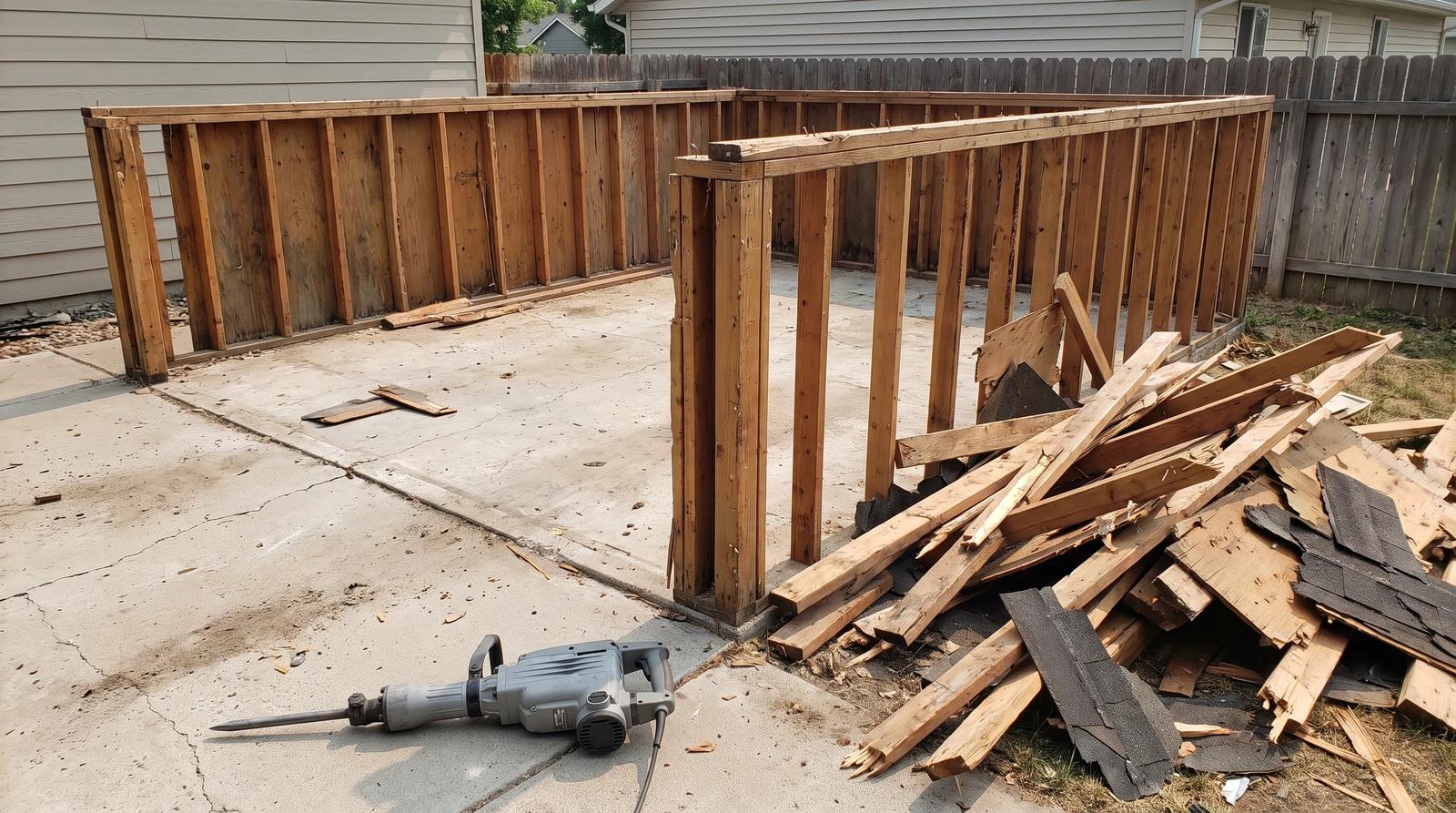
Demolishing a Garage: How It Comes Down, Slab and All
Demolishing a garage starts before anything is torn down. The power, gas and water get shut off and capped, the building gets emptied, and the permit gets pulled. Only then do the roof and walls come down, followed by the slab if it's going too.
Most of what changes the job in Boise and the rest of the Treasure Valley gets decided up front. That's attached or detached, wood or block, floor in or out, and whether the old roof needs testing. Here's what to learn about each one.
How do you tear down a garage?
You tear down a garage in a set order. Utilities go off and the permit comes first, then the building gets emptied. Next the roof, the walls and the slab come down.
Sorting, hauling and cleanup finish the project and clear the site. Following that order is how a crew gets through a garage demolition safely. Skip a step and you can end up with a live wire in the debris pile.
Shut off utilities and get the permit
Most of these buildings have power, and plenty have gas for a heater or water for a sink. Every line gets disconnected and capped before demolition, garage lights included. Shutoffs take time to schedule, so start early.
Many municipalities require demolition permits, and Boise is one of them. You'll need to get a permit before anything comes down.
The building department usually wants the utilities handled first. Many demolition contractors handle the permit application as part of the job, so it's worth asking.
Heads up: A building turned into a shop often has a subpanel fed from the house. That feed has to be cut off at the house panel, not just switched off in the shop.
Empty it out: remove all items, sort for donation
Before the crew starts, you'll want to remove all items from inside. That means shelving, workbenches, tools and the boxes in the rafters.
Sorting first keeps a lot out of the landfill. Usable items can be donated, metal goes to scrap, and paint, chemicals and fuel need their own disposal.
Rather skip the emptying? The crew can handle removal of whatever's left. Much of it can be donated or recycled instead of going to the Ada County landfill.
Detached vs. attached: why attached takes more care
A detached garage is the simpler job. The only things to protect are fences, trees, overhead lines and the neighbor's yard.
An attached garage shares at least one side, and often a roofline, with the house. Careful hand work along that joint is a necessity to protect the house, roof and foundation. It also means:
- The shared wall may be fire-rated and has to stay intact.
- Drywall on the shared side usually comes off, since that face will soon be outdoors.
- House wiring or plumbing can run through the building.
- The roof tie-in has to be sealed against water.
- That side of the house is left open and needs to be made weather-tight.
Worth asking: Who closes up the open side of the house afterward, and when? Line that up early so it isn't left open in a storm or cold snap.
Roof first, then walls, then the slab
Once the site's ready, the structure comes down from the top, so the collapse goes where the crew wants. For safety, everyone else stays well back.
With a wood-frame building and good access, an excavator pulls it inward onto itself, away from fences and the house. Tight North End alley lots can mean more hand labor and smaller machines.
Sort, haul and clean up
Debris removal starts as the building comes down. Drywall, framing, roofing, metal, concrete and junk get sorted, since each goes somewhere different.
Wood and metal can often be recycled. Clean concrete goes to a recycler, and mixed construction debris goes to the landfill. Then the site gets a final pass: nails picked up with a magnet, scraps raked out and the ground left level.
How to get rid of a concrete garage?
You get rid of a concrete garage with heavier equipment and more hauling than a wood one. The upside: concrete removal usually ends at a recycler, not the landfill.
Concrete block or brick vs. wood framing
Wood framing is light and breaks up fast. Block and brick are heavy, may be filled with grout and rebar, and often sit on deeper footings. A block building can look small and still weigh a lot.
Slab removal, or keeping the slab
Slab removal is optional. Putting in lawn, a garden or a different building? Then the floor and footings get broken out with a hydraulic breaker and hauled.
Thickness, rebar, footing depth and access all change the job. A floor tucked behind the house is harder to reach than one off a driveway.
Rebuilding in the same spot? Keeping the slab might work, and the FAQ below covers what to check.
Where broken concrete goes
Broken concrete can usually be recycled into gravel base for roads, driveways and new pads. It has to be fairly clean, though. Loads mixed with wood, trash or dirt may get turned away.
Good to know: Recyclers often take broken pieces with rebar still in them and pull the steel out themselves. Call ahead, since each one sets its own rules.
Demolishing a garage by hand or with equipment: which makes sense?
Garage demolition is sometimes a fair DIY project. Choosing to demolish it yourself can work for a small wood building that's keeping its floor, if you have the time. Most others go better with a crew.
What doing it by hand really involves
Doing it by hand means stripping the roofing, cutting the framing into pieces and lowering it without it falling on you. It's slow, heavy, dusty work.
Roofing and broken block can push a roll-off dumpster past its weight limit. You still have to get a permit and line up the utility shutoffs, too.
Safety is the biggest issue. Framing can fall the wrong way once the roof's off, and nails are everywhere. Older materials can also hold things you don't want to breathe.
If you go ahead, team up with a partner, wear real protective gear and don't stand under anything unbraced.
When a crew and machinery make more sense
Professional garage demolition makes more sense with a slab coming out, block or brick sides, an attached building or tight access. A demolition contractor with an excavator and skid steer can finish in a short stretch what might take you many weekends.
A crew with the right gear can handle garage demolition safely. If your project has a deadline, garage demolition makes more sense as a hired job too. When you compare crews, ask which services the price covers: permit, hauling, final pass.
Season matters too. Hot, dry summers mean dust control, and winter can leave access frozen or muddy.
Residential demolition services can handle most garages. Still, if yours is small and wood, doing it yourself is a real option.
Old roofing: why a possible asbestos roof gets tested first
Older shingles, siding and roofing felt can contain asbestos, and only a lab test can tell you. It's lower risk left alone; breaking it up releases the fibers.
If the roof has original shingles or wavy cement panels, have a certified inspector test them first. If it's positive, a qualified abatement contractor usually handles the removal. Your permit office can tell you what's required.
Garage demolition FAQ
What are the three types of demolition?
Total demolition takes the whole structure down, and selective demolition removes one part. Deconstruction takes a building apart by hand to save the materials. A detached garage, one separate from the house, is usually total.
How much does garage demolition cost?
Your demolition cost depends on size, building type, attached or not, slab in or out, access and hauling. A two-car building has more to break up and haul than a one-car, so it costs more. Garage demolition pricing usually goes by the space and work involved, so get an on-site estimate and a firm price before any work starts.
Do you need a demolition permit in Boise?
Usually, yes. Many municipalities require demolition permits, and Boise wants one before you demolish a garage. Other cities set their own rules, so check with yours.
Can you keep the slab and build on it?
Sometimes. It needs to be in good shape, without major cracks or heaving, and the footings must meet current code. Have the building department or an engineer check first.
Getting it taken down
It all comes down in order: utilities and permit, contents, roof, walls, slab, cleanup. Settle the big calls up front, and you're on your way to efficiently demolishing your garage.
Boise Demolition does free on-site estimates across the Treasure Valley, from Boise and Eagle to Nampa and Caldwell. We can take on the complete teardown, from the permit to the final pass.
Related reading: Residential Demolition Plan: What Goes Into One Before a House Comes Down and Residential Demolition Specifications: What a House Teardown Spec Covers.
Same-day service is available when the schedule allows, and we take cash, card and Venmo. Give us a call at (208) 296-6153.
Planning a Demolition Project?
We handle permits as part of our demolition services throughout Boise, Meridian, Nampa, and the Treasure Valley. Call for a free estimate.
Call (208) 296-6153More From Our Blog
Demolition Labor Cost per Hour vs. Total Demolition Cost on a Teardown
Demolition labor cost per hour tells you little about a teardown. Learn what really drives house demolition costs and why crews price by the job.
Do I Need a Permit for Building Demolition? Who Handles What
Do I need a permit for building demolition? Usually, yes. Here's what comes before the application, who handles each step and what moves the cost.
Residential Demolition Plan: What Goes Into One Before a House Comes Down
A residential demolition plan covers utilities, hazardous materials testing, the teardown order, debris and site protection. Here's what goes in one.
