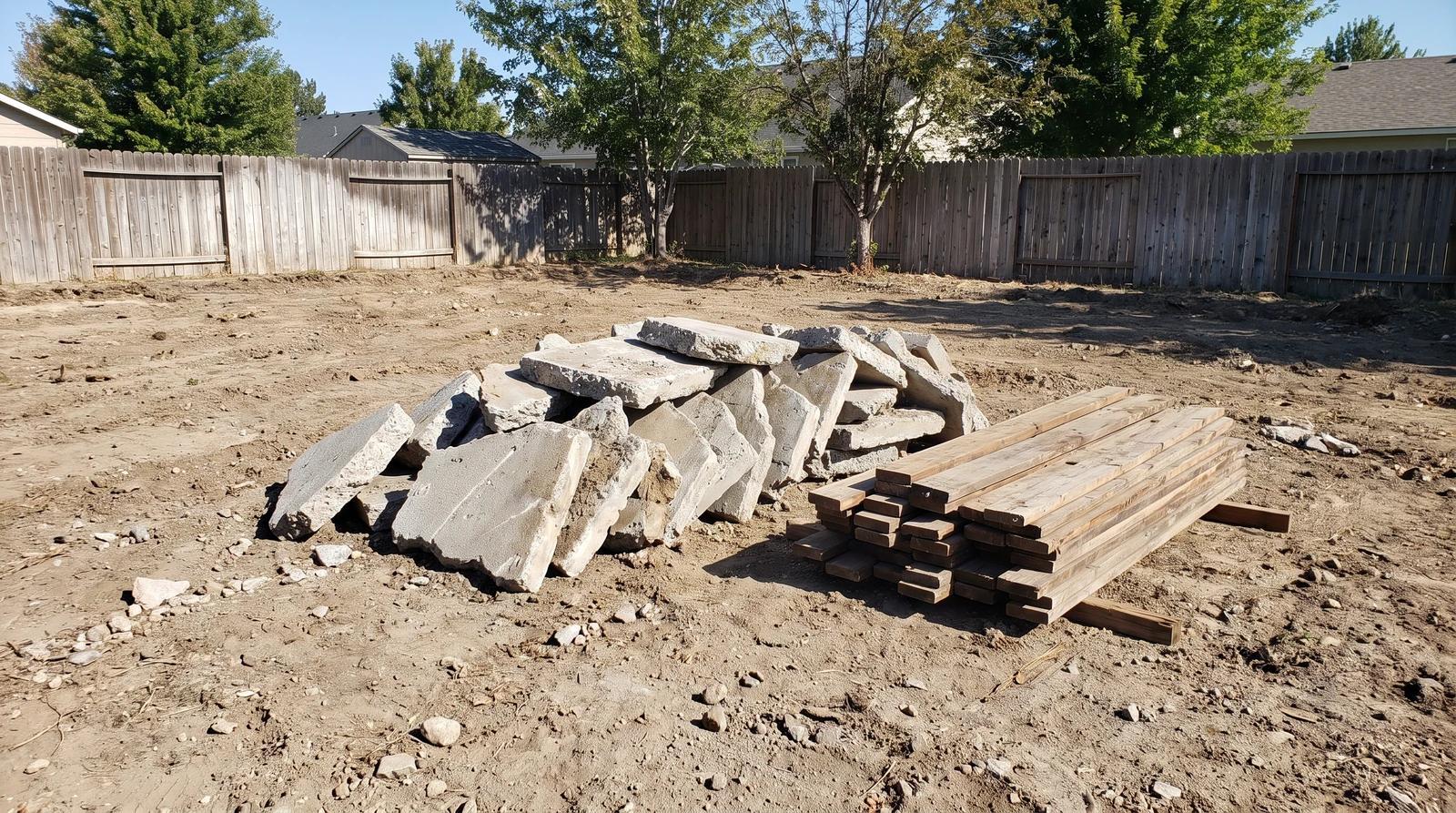
Demolition & Site Clearing: What Demolition Services Include After Teardown
Demolition & site clearing means taking a structure down and then clearing what's left: the slab, footings, concrete and debris. The goal is a clear site that's ready for site development or new construction. The teardown is the loud part. The clearing decides if you get a usable site or a pile of broken concrete.
In Boise and across the Treasure Valley, that second half is easy to overlook. Here's what comes out, where it goes, and how demolition and site clearance get agreed on before work starts.
What are the different types of demolition work?
Residential and commercial demolition both come down to what's being removed: a whole building, a smaller outdoor structure, a pool or hot tub, or concrete. Each one leaves a different mess on the site, so each needs its own clearing plan.
We're a licensed and insured contractor. Our crew provides demolition contracting services for exterior and whole-structure work only.
Whole houses and garages
Building & structure demolition is the biggest job on the list. A house or detached garage comes down with its roof, framing, siding and anything attached to it. Then the clearing starts: the foundation, the slab, any concrete in the scope, and all debris.
Older homes, like many in the North End or on the Bench, can hide surprises in their old siding and roofing material, and those may need abatement first.
Heads up: Older buildings often need an asbestos inspection before a permit is issued. If something tests positive, abatement and any environmental remediation have to finish before demolition activities start, and that can push the schedule back.
Sheds, decks and carports
These are smaller jobs, but they still have parts people forget. A shed might sit on a concrete pad or on piers. A deck usually has posts set in concrete footings. A carport is often bolted to a slab or set in its own footings.
Taking down the wood or metal goes fast. Getting the footings out is what makes the site usable again.
Pools and hot tubs
Hot tub removal is mostly a disconnect and haul-away job. The power gets shut off and disconnected first, then the tub goes out whole or in pieces, based on how tight the access is.
In-ground pools are a different animal. The shell gets broken up during demolition excavation, then demolition earthwork fills and packs the hole so the ground doesn't sink later. Decide early if the shell comes out fully or gets buried. It can affect what you're allowed to build there later.
Concrete: slabs, patios and driveways
Concrete removal is often part of a bigger job. Cracked driveways, old patios, sidewalks and leftover slabs all land here.
Thickness and rebar are the big factors. A thin patio breaks up fast. A thick slab with steel in it takes heavier equipment, more time and more trips to haul.
What demolition & site clearing includes
This work has four parts. The crew brings the existing structures down, takes out what held them up, sorts the debris and leaves the lot the way you agreed. A quote for clearing & demolition services should spell all of that out, along with a firm price.
Taking the existing structures down
Before anything comes down, the power, gas, water and sewer need to be shut off and capped for safety. An 811 locate request gets buried lines marked before any digging. The permit has to be in hand, too. We handle the permit application for you.
Site demolition involves the systematic dismantling of the structure in a planned order. Doors, windows and other material worth saving come off first, then the roof and structural framing. The crew works around the fences, trees and neighbors you want left alone.
Removing the foundation, footings and concrete
Once the walls and roof are gone, you've still got foundation walls, the footings under them, the slab, and maybe a basement or crawlspace. All of that sits partly or fully below grade and has to be dug out.
What comes out depends on your next step. If construction is coming next, your builder may want it all gone down to native soil. If the lot's turning into yard, the concrete still has to go, and any basement hole gets filled.
Worth asking: "Are the footings included, or just the slab?" Get the answer written into the estimate. Footings sit below grade, so they're easy to leave out of a quote by mistake.
Sorting all debris to donate, recycle or dispose of
Not everything ends up at the landfill. Debris gets sorted as it comes down so useful pieces have somewhere better to go.
- Concrete and asphalt can often be recycled instead of buried.
- Metal, like steel framing, rebar, metal siding and old fencing, goes to recycling.
- Usable items, like lumber, doors and windows in good shape, can be donated.
- Everything else, like mixed construction debris, goes to the landfill or the right disposal spot for it.
Sorting as the work goes means less gets buried, and it's easier to quickly dispose of what's left.
What the lot looks like when the crew leaves
When the job's done, the site should match what you agreed to at the estimate. Usually the structure, the concrete and the debris are gone, holes are filled, and the ground is roughly graded.
Finish work usually isn't included. Fine grading, landscaping and other sitework belong to the next phase of site development, often handled by a builder or a landscaping and concrete services company.
Got stumps or overgrown vegetation in the way? The work of removing trees and stumps is easy to miss, so bring it up at the estimate so it's clearly in or clearly out. Bare dirt can also wash into the street in a spring storm, so ask if your project needs stormwater or erosion control, too.
How long does demolition of a building take?
It depends on prep, size, access and how much concrete has to come out. The teardown itself is often the shortest part. Permits, utility disconnects and inspections tend to set the pace.
How long does it take to prepare a building for demolition?
Prep takes as long as the paperwork and the utilities take. Each city and county in the valley runs its own permit process, with its own checklist.
A typical prep list looks like this:
- A hazard inspection, plus any abatement it calls for
- Shutoffs and disconnects from each utility
- The permit application
- An 811 locate request for buried lines
- Moving out anything you want to keep, from the building and the yard
Quick tip: Start the utility calls as soon as you know the building's coming down. Disconnects are often the slowest item on the list, and many permit offices want them done before they'll sign off.
What makes demolition go faster or slower: size, access, concrete and disposal
Once prep is done, a handful of things move the timeline:
- Size. A bigger building means more to take down and haul.
- Access. A wide-open site in Kuna is easier to work than a tight North End lot. Alleys and overhead power lines slow things down.
- Concrete. Thick slabs, basements and footings with lots of steel take longer to break and load.
- Hauling. More sorting and more runs to recycling and the landfill add time. Good truck access helps the crew load up and quickly dispose of each load.
- Season. Frozen ground makes digging out footings harder in winter. Hot, dry summers mean more water for dust control.
Frequently asked questions
What does clearing a site mean?
It means removing what's on a site so it's ready for its next use. After a teardown, that usually covers the foundation, concrete, debris and sometimes plants and trees, leaving the ground open and roughly level.
What are the three types of demolition?
People usually name three: total, selective and deconstruction. Total is the full destruction of a structure, and selective takes out one part, like a garage while the house stays. Deconstruction takes things apart piece by piece so more can be reused.
How much does demolition cost?
It depends on the size of the structure, how much concrete comes out, access, hauling, permits and any abatement. Any company offering expert demolition services has to see the property to give you a real number. Our estimate is free and ends in a firm price with no hidden fees.
Do you have to remove the foundation when a house is torn down?
Not always, but it usually comes out. If you're rebuilding, old footings can get in the way of the new build. Your plans and your city's rules decide it.
Getting a lot that's actually clear for construction
The teardown is the easy part to picture. What matters is whether the lot is ready for construction when the crew pulls out. Ask what comes out, where it goes and what the lot will look like at the end, and get those answers in writing before work starts.
Related reading: Residential Demolition Specifications: What a House Teardown Spec Covers and Residential Demolition Notes: What They Say and Why They Matter.
Want someone to walk your property and tell you exactly that? Our residential demolition services cover houses, garages, sheds, decks, carports, pools, hot tubs and concrete across Boise, Meridian, Eagle, Star, Kuna, Nampa and Caldwell. Every job starts with a free estimate, and the price is set before anything is touched. We take cash, card and Venmo. Give us a call at (208) 296-6153 when you're ready to talk it through.
Planning a Demolition Project?
We handle permits as part of our demolition services throughout Boise, Meridian, Nampa, and the Treasure Valley. Call for a free estimate.
Call (208) 296-6153More From Our Blog
Demolition Labor Cost per Hour vs. Total Demolition Cost on a Teardown
Demolition labor cost per hour tells you little about a teardown. Learn what really drives house demolition costs and why crews price by the job.
Demolishing a Garage: How It Comes Down, Slab and All
Demolishing a garage, step by step: utilities and permits, attached vs. detached, block walls, slab removal and when an old roof needs asbestos testing.
Do I Need a Permit for Building Demolition? Who Handles What
Do I need a permit for building demolition? Usually, yes. Here's what comes before the application, who handles each step and what moves the cost.
