Full Demolition vs Partial Demolition: Which Do You Need?
Some projects require taking everything down. Others just need targeted removal of specific areas. Understanding the difference helps you plan—and budget—your Boise demolition project correctly.
Let's break down when each approach makes sense, what's involved, and the cost implications.
What Is Full Demolition?
Full demolition means taking down an entire structure—house, garage, commercial building, whatever it is—down to the foundation or completely including the foundation.
When full demolition makes sense:
The structure is beyond repair. Foundation problems, severe water damage, structural failure, or extensive pest damage can make renovation impractical. Sometimes starting fresh is cheaper than trying to save what's there.
You're building something new. Many Boise lots have old, outdated structures that need to go before new construction can happen.
The building doesn't meet current codes. Bringing some older structures up to code costs more than demolition and new construction.
You've acquired a property with a structure you don't want. Inherited homes, purchased lots with existing buildings, or properties with abandoned structures.
What Is Partial Demolition?
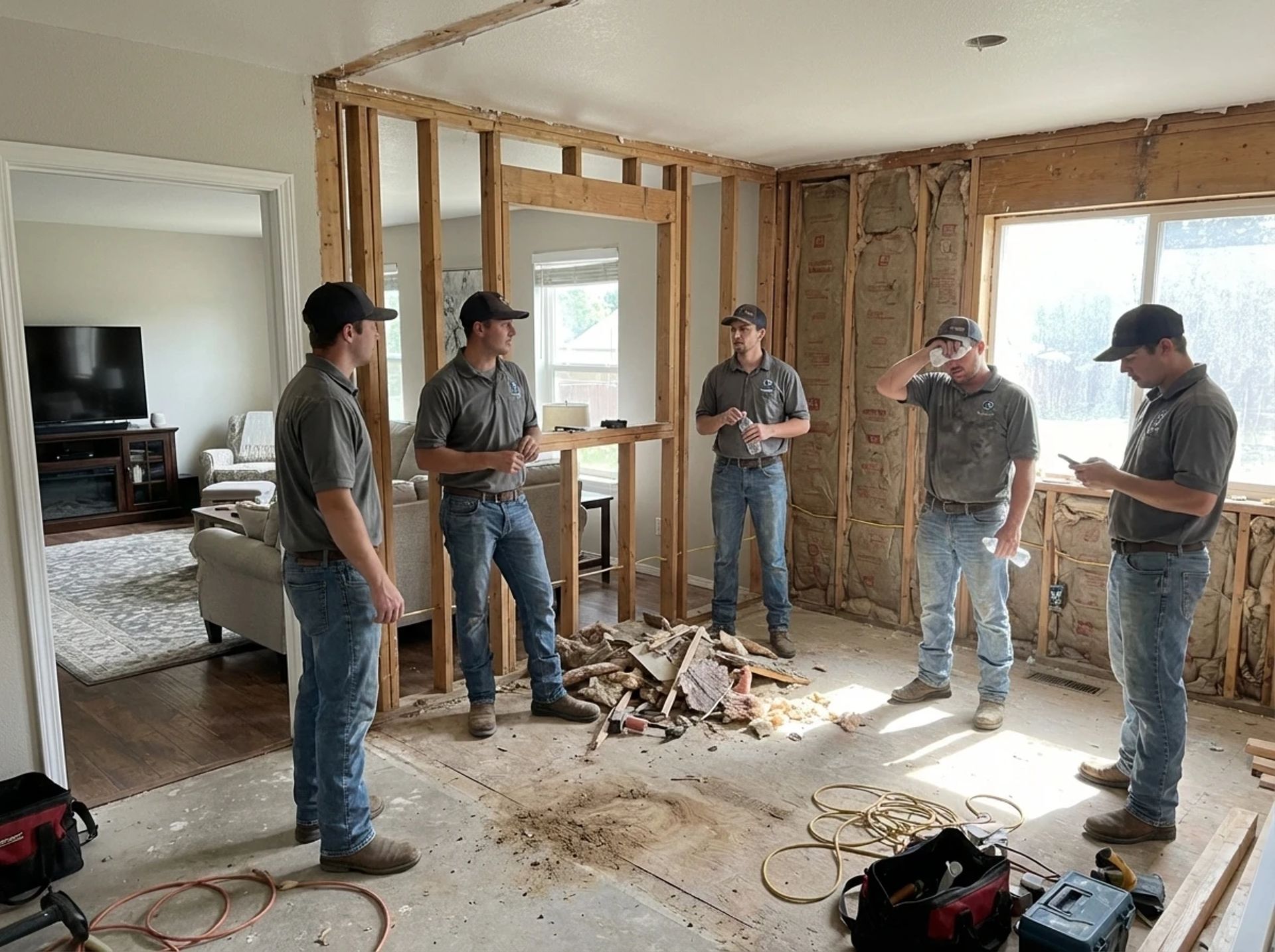
Partial demolition (also called selective demolition) removes specific portions of a structure while leaving the rest intact. This is more common in renovation projects.
Common partial demolition scenarios:
Interior gut. Removing interior walls, floors, ceilings, and finishes while keeping the exterior shell. Common in whole-house renovations.
Addition removal. Taking off an old addition—sunroom, porch, garage add-on—while keeping the original structure.
Wall removal. Removing interior walls to open up floor plans. May be load-bearing or non-load-bearing.
Room conversion. Stripping a room (kitchen, bathroom, basement) down to studs before renovation.
Outbuilding removal. Removing one structure (old shed, detached garage) while keeping the main building.
Which Is More Complex?
You might think partial demolition is simpler since you're removing less. That's not always true.
Full demolition is often more straightforward. You're taking everything down, so there's less concern about protecting remaining structures. The process can move quickly because you don't need to work around what stays.
Partial demolition requires more precision. You need to protect areas that remain, work around existing utilities, maintain structural integrity, and ensure clean transitions where old meets new.
Removing a wall that's load-bearing, for example, requires temporary supports, careful work around existing framing, and often more cleanup than taking down a whole room.
The skill involved is different. Full demolition is about efficiency and thoroughness. Partial demolition is about precision and protection.
Cost Factors for Each Type
Both types of demolition involve similar cost categories, but the proportions differ:
Full demolition is usually priced per square foot for residential structures in the Boise area. The total depends heavily on the size of the home, construction type, foundation, and how complex the teardown is.
Partial demolition is harder to estimate by square foot because scope varies so much. An interior gut of a kitchen is a different beast from removing an entire addition. It depends entirely on what's involved.
Permit Requirements
Both types typically require permits in Boise and surrounding areas, but the requirements differ:
Full demolition requires a demolition permit, utility disconnections, asbestos inspection (for pre-1985 buildings), and sometimes neighborhood notification.
Partial demolition may be covered under a renovation or building permit rather than a separate demolition permit. If you're removing walls, changing the footprint, or affecting structural elements, permits are required.
Even interior-only demolition may require permits if it involves structural changes. Check with the City of Boise or your local jurisdiction before starting work.
How to Decide What You Need
Consider these questions:
What's the end goal? New construction on the site requires full demolition. Renovation typically involves partial demolition.
What condition is the structure in? Severe foundation issues, structural damage, or extensive hazardous materials might make full demolition more practical than selective removal.
What's the total project cost? Compare the cost of partial demolition plus renovation versus full demolition and new construction. Sometimes new construction is actually cheaper.
Do you have historical or sentimental value? Some structures are worth preserving even if renovation costs more. That's a personal decision.
The Bottom Line
Full and partial demolition serve different purposes. Full demo clears the slate for new construction. Partial demo supports renovation while preserving parts of the structure.
Neither is inherently better—it depends on your project goals, the building's condition, and the overall economics.
If you're not sure which approach makes sense for your Treasure Valley project, we can help you evaluate the options. Sometimes looking at a structure in person makes the right choice clear.
Need Help Deciding?
We handle both full and partial demolition throughout Boise, Meridian, Nampa, and the Treasure Valley. Call for a free assessment.
Call (208) 296-6153